Educational Transformation and Digital Literacy: A Case Study and Success Story
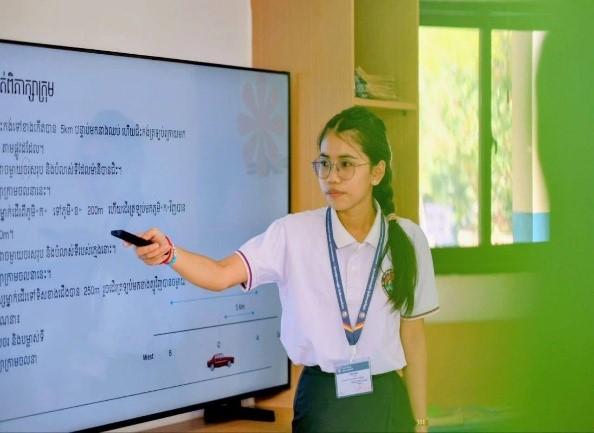
Ms. Sum Bopha is a twenty-four-year-old Physics teacher with three years of teaching experience, currently dedicated to her teaching profession at Aranh Raingsey Lower Secondary School in Siem Reap Province. As a young and highly motivated educator, she constantly faced numerous challenges in developing students' capacities to meet the demands of modern education.
Before the arrival of the New Generation School Initiative, commonly known as the NGSI implemented by the KAPE organization, the teaching and learning conditions at Aranh Raingsey Lower Secondary School were significantly limited and faced severe obstacles. During that period, students suffered from a severe lack of foundational knowledge in information technology and mathematics, which caused a major bottleneck in understanding physics, a subject that fundamentally requires deep calculation and analytical thinking. Not only the students, but Ms. Sum Bopha herself lacked a comprehensive and deep understanding of diverse modern teaching methodologies. Instruction at that time relied almost entirely on textbook reading and rote memorization of formulas without sufficient educational materials for practical experiments, which consequently left students feeling disengaged, slow to progress, and unable to see the connection between classroom theories and daily life problem-solving.
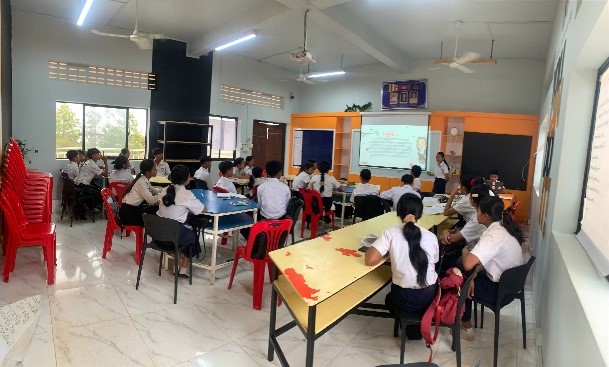
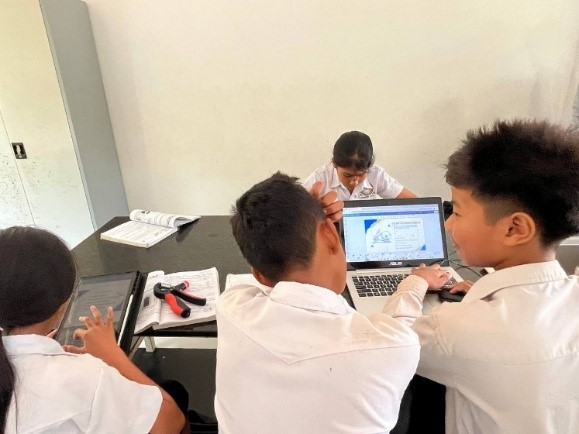
However, these difficult circumstances were completely transformed following the strategic intervention of the New Generation School Initiative. The project provided holistic and comprehensive support, ranging from technical assistance through the organization of advanced science teaching methodology training in Kampong Cham Province facilitated by KAPE, to the provision of modern teaching materials, educational technological devices, financial budgets for classroom setup, and strong moral support for the teaching staff. Receiving this training was considered by Teacher Bopha as a valuable new discovery in her professional life because it explicitly unfolded and clarified many teaching strategies that she had previously encountered but never fully comprehended. Following the initial training, she pursued further self-study on lesson design software, discovering various advanced educational functions that exceeded what was demonstrated in the training sessions. She then integrated these digital tools into her actual classroom instruction, leading to rapid development among her students in technology usage and the adoption of artificial intelligence to assist their learning. The students even became proficient in constructing complex mathematical and physical equations within the design application, making the entire learning process much smoother and easier than before.
The immense positive impact of using the teaching aids and technology provided by the project lies in the shift from rote memorization of theories to practical application, which bridges physics concepts with real-world problem-solving in students' daily lives. These technologies have effectively nurtured twenty-first-century skills among students, including critical thinking, problem-solving, and teamwork, while enabling the teacher to serve as an efficient facilitator of learning who fully supports student competency assessments aligned with international PISA standards. Although she has never encountered dropout issues, she successfully motivated and guided students who were completely tech-illiterate to become proficient in utilizing digital tools to assist their own education. In terms of pride and future vision, she has transformed herself from a traditional, theory-based teacher into a modern educational facilitator who confidently guides students through Science, Technology, Engineering, and Mathematics, known as STEM projects. Concurrently, the school has evolved into a modern learning hub where students are given opportunities to create tangible projects and participate in various competitions, representing the greatest pride of the institution. Regarding experience sharing, she plans to disseminate these insights through technical council meetings within the school’s Professional Learning Community, or PLC, and participate in regional or national workshops, similar to her past opportunity where she presented her research findings at the National Education Congress. She expressed her deepest gratitude to KAPE and the donors, noting that this support has not only transformed the school's infrastructure but has also opened doors for rural students to receive a high-standard education on par with urban students.
Reflecting her strong commitment and perspective, Sum Bopha stated in a comprehensive and detailed manner that “The development of the education sector requires a shift in mindset and an openness to accept mutual feedback. Years of experience do not always guarantee profound insights; what matters most is the ability to listen and learn together. No matter how advanced the tools are, without a lifelong learning mindset, success cannot be achieved. I hope that Aranh Raingsey Lower Secondary School will serve as a model that inspires other schools to embrace change in order to collectively build Cambodian youth resources for the digital era.”
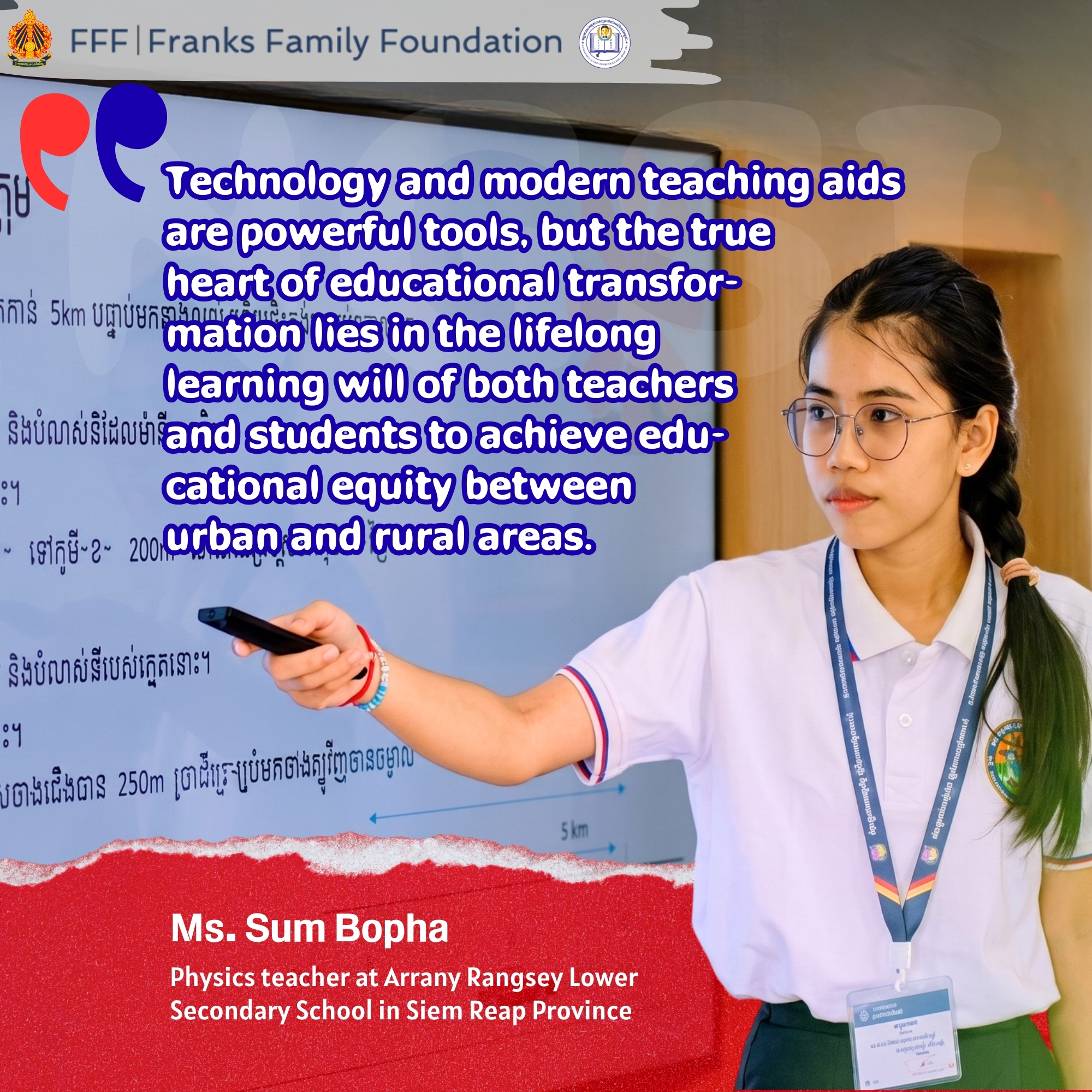
Simultaneously, to provide a concise yet powerful reminder and encouragement, she further added that “Technology and modern teaching aids are powerful tools, but the true heart of educational transformation lies in the lifelong learning will of both teachers and students to achieve educational equity between urban and rural areas.”
Ultimately, her primary objective is to see her school become a model training ground and to encourage all teachers to collaborate closely regardless of age or experience, aiming to collectively build capable human resources to lead the nation in the digital age.