About KAPE
Cambodia's largest and longest-serving local education NGO — a laboratory of innovation for the national education system.
Kampuchea Action to Promote Education (KAPE) is the largest local non-governmental organization (NGO) in the formal education sector in Cambodia. Headquartered in Kampong Cham Province and with branch offices in Phnom Penh, KAPE works across preschools, primary schools, secondary schools, and tertiary education levels to improve educational quality and ensure vulnerable children and youth have access to life-changing learning opportunities.
Organizational Overview
KAPE operates as a primary driving force for innovation and policy reform in Cambodia’s formal education system. The organization designs and implements highly impactful projects in collaboration with the Ministry of Education, Youth and Sport (MoEYS), international donors, and local communities.
Alignment of KAPE Projects by Technical Subsector
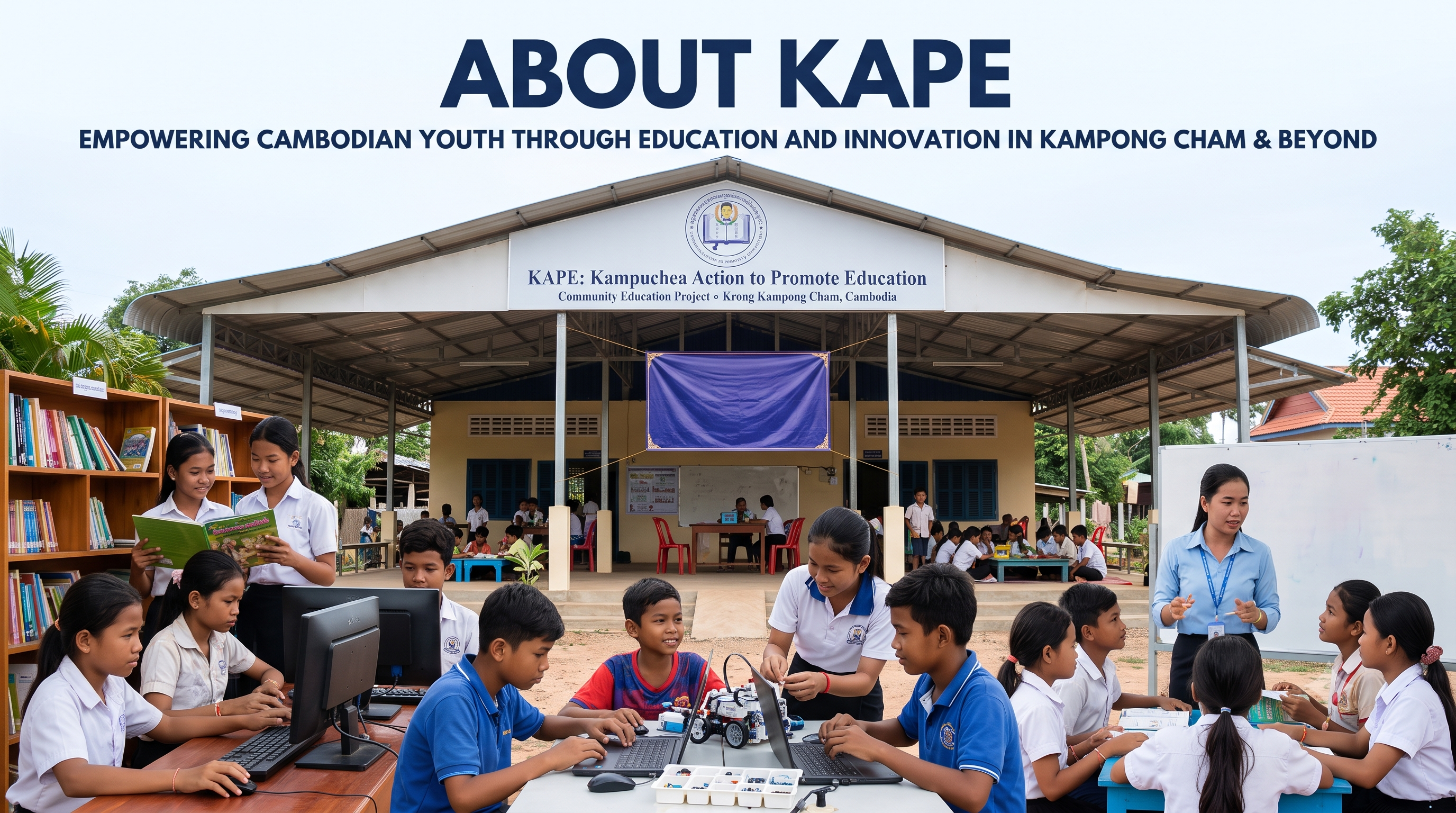
The ten subsectors shown below represent KAPE’s holistic approach to tackling education at every level, from early childhood infrastructure to high school career readiness. Here is a breakdown of what each critical subsector entails:
1. Charter School Development (New Generation Schools): In the Cambodian context, "Charter School Development" primarily refers to KAPE’s flagship New Generation Schools (NGS) initiative. This model grants public schools high levels of autonomy to innovate their curriculum and management. In exchange for this freedom and increased investment, the schools face strict accountability standards for their performance. NGS breaks the cycle of informal private tutoring by paying teachers higher salaries to focus entirely on their official classroom duties. In all, KAPE supports 22 New Generation Schools.
2. ICT in Education: This subsector focuses on bridging the digital divide by integrating Information and Communication Technology (ICT) directly into the curriculum. KAPE outfits schools with computer labs, smart TVs, and mobile learning devices. It also trains teachers to use digital platforms (like e-learning tools and digital libraries) to make lessons more interactive and accessible.
3. Teacher Development: Moving away from traditional rote memorization requires massive teacher upgrading. KAPE invests heavily in in-service training, mentoring, and the creation of Professional Learning Communities (PLCs). Teachers are trained in modern, student-centered pedagogies (e.g., constructivism, project work, etc.) and positive discipline, empowering them to become facilitators of critical thinking rather than just lecturers.
4. Inclusive Education: This subsector ensures that marginalized groups are not left behind. KAPE implements scholarships for girls, provides specialized support for students with disabilities, and develops multilingual education programs for indigenous ethnic minorities (such as those in Ratanakiri). The goal is to remove financial, physical, and social barriers to enrolment and retention.
5. Early/Upper Grade Reading: Foundational literacy is the bedrock of all subsequent learning. KAPE aligns with national reading standards to implement structured phonics programs, provide high-quality reading materials, and conduct Early Grade Reading Assessments (EGRA). The agency focuses on both early decoding skills for young learners and reading comprehension strategies for upper grades.
6. Preschool Programming: Early Childhood Care and Education (ECCE) is vital for school readiness. KAPE supports state and community-based preschools by training early childhood educators, developing age-appropriate play-based curricula, and engaging parents in their children’s early development to ensure they enter Grade 1 prepared to succeed.
7. Infrastructure Design: KAPE’s infrastructure projects go beyond just building four walls and a roof. They focus on designing "21st-century learning environments." This includes building specialized science labs, modern libraries, classroom buildings with modern configurations, computer rooms, maker spaces, and inclusive WASH (Water, Sanitation, and Hygiene) facilities that are accessible to ensure a safe, conducive environment for all students.
8. Library Development: Rather than treating libraries as quiet, dusty storage rooms for books, KAPE transforms them into active, vibrant learning hubs. This involves modernizing the space with attractive and multi-functional furniture, introducing digital e-readers and m-learning facilities, supplying culturally relevant storybooks, and training librarians to run interactive reading activities that foster a genuine love of reading.
9. Life Skills & Career Counselling: To combat dropout rates and prepare students for the workforce, KAPE integrates life skills into secondary education. This includes financial literacy, critical thinking, and communication skills. The agency also provides dedicated career counselling to help students navigate pathways to higher education or vocational training, matching their skills to market demands. KAPE also supports the use of e-counselling apps to increase the accessibility of counselling services to all students.
10. STEM Education: Science, Technology, Engineering, and Mathematics (STEM) is a high priority, particularly within the New Generation School system. KAPE shifts science education from textbook theory to hands-on, applied learning. They equip schools with robotics kits, applied science labs, and coding classes, and they organize STEM fairs to build Cambodia's future workforce of innovators and engineers.
History and Evolution
KAPE’s history mirrors the rebuilding and modernization of Cambodia’s post-conflict educational ecosystem.
1996 – 1999: The Seeds of CAPE
KAPE grew out of a donor-funded initiative known as the Cambodia Assistance to Primary Education (CAPE) Project, established in April 1996 by USAID. The goal of CAPE was to improve the instructional quality of rural schools by testing the "school cluster" system, which grouped neighboring schools together to share resources, materials, and training.
When the international project funding unexpectedly concluded in 1997, a dedicated group of local Cambodian staff members and technical specialists at the Kampong Cham provincial site refused to let the progress stop. Led by key educational architects, including co-founder and long-time technical advisor Kurt Bredenberg, the team partnered with the Provincial Office of Education to maintain their grass-roots technical support.
1999: Official Foundation as a Local NGO
Recognizing the need for a permanent, locally driven entity, the committee mentioned above formalized their structure. In October 1999, the organization officially registered with the Ministry of Interior as a non-profit local NGO under the name Kampuchean Action for Primary Education (KAPE).
During its early years, KAPE focused strictly on improving primary education and building school-community ties through Parent-Teacher Associations (PTAs) and child-friendly school programming in a few select provinces.
2011 – 2019: Scaling up and Systemic Reform
As KAPE built a reputation for transparency rigorous research, and applied success, its relationship with MoEYS deepened. Between 2011 and 2015, KAPE piloted the "Beacon Schools Initiative (BSI)," which eventually evolved into the national New Generation Schools (NGS) framework.
This marked a massive shift in Cambodian educational history: for the first time, the Ministry of Education took the unprecedented step of providing state funding to a non-state actor (KAPE) to scale up an educational reform model nationwide.
To accurately reflect its expanding footprint—which now stretched far beyond kindergarten & primary education and into high schools, university scholarships, and teacher training institutes—the organization reached a milestone in 2019. The Ministry of Interior approved an official name change to Kampuchea Action to Promote Education, retaining its widely trusted acronym, KAPE.
KAPE Today
Entering its third decade of operation, KAPE has scaled up significantly from its humble provincial roots. The organization manages between 15 and 20 at any one time that are funded by a variety of donors including private foundations, the Cambodian government, and bi- and multilateral organizations (e.g., UNICEF, UNESCO, ADB, etc). These programs directly benefit tens of thousands of students and thousands of educators across more than a dozen provinces, KAPE continues to serve as the blueprint for educational evolution in Cambodia.
Three decades.
Countless beginnings.
KAPE across Cambodia
Be part of the next chapter
Partner with us, support a child's education, or join our team.